 R package TSP - Infrastructure for the Traveling Salesperson
Problem
R package TSP - Infrastructure for the Traveling Salesperson
Problem



Maintainer: Michael Hahsler
The TSP package (Hahsler and Hornik 2007) provides the basic infrastructure and some algorithms for traveling salesman problems (symmetric, asymmetric, and Euclidean TSPs). The package provides some fast implementations of simple algorithms including:
Most algorithms are optimized to work on symmetric TSPs stored as distance matrices, but asymmetric TSPs (ATSPs) and Euclidean TSPs (ETSPs) are also supported.
The package can read and write the TSPLIB format (Reinelt 1991) and it can solve many of the problems in the TSPLIB95 problem library (local copy of the archive).
The following R packages use TSP: archetypes, cholera, condvis, CRTspat, ForagingOrg,
ggEDA, isocir, MLCOPULA, nilde, nlnet, PairViz, sensitivity,
seriation, sfnetworks, tspmeta, VineCopula, wompwomp
To cite package ‘TSP’ in publications use:
Hahsler M, Hornik K (2007). “TSP - Infrastructure for the traveling salesperson problem.” Journal of Statistical Software, 23(2), 1-21. ISSN 1548-7660. doi:10.18637/jss.v023.i02 https://doi.org/10.18637/jss.v023.i02.
@Article{,
  title = {TSP -- {I}nfrastructure for the traveling salesperson problem},
  author = {Michael Hahsler and Kurt Hornik},
  year = {2007},
  journal = {Journal of Statistical Software},
  volume = {23},
  number = {2},
  pages = {1--21},
  doi = {10.18637/jss.v023.i02},
  month = {December},
  issn = {1548-7660},
}Stable CRAN version: Install from within R with
install.packages("TSP")Current development version: Install from r-universe.
install.packages("TSP",
    repos = c("https://mhahsler.r-universe.dev",
"https://cloud.r-project.org/"))Load a data set with 312 cities (USA and Canada) and create a TSP object.
library("TSP")
data("USCA312")

tsp <- TSP(USCA312)
tsp
## object of class 'TSP'
## 312 cities (distance 'euclidean')Find a tour using the default heuristic.
tour <- solve_TSP(tsp)
tour
## object of class 'TOUR'
## result of method 'arbitrary_insertion+two_opt' for 312 cities
## tour length: 40632Show the first few cities in the tour.
head(tour, n = 10)## Santa Cruz, CA San Jose, CA Stockton, CA Carson City, NV
## 245 242 268 48
## Reno, NV Sacramento, CA Berkeley, CA Oakland, CA
## 219 225 26 186
## San Francisco, CA Hilo, HI
## 241 119Visualize the complete tour.
library(maps)
data("USCA312_GPS")

plot((USCA312_GPS[, c("long", "lat")]), cex = 0.3)
map("world", col = "gray", add = TRUE)
polygon(USCA312_GPS[, c("long", "lat")][tour, ], border = "red")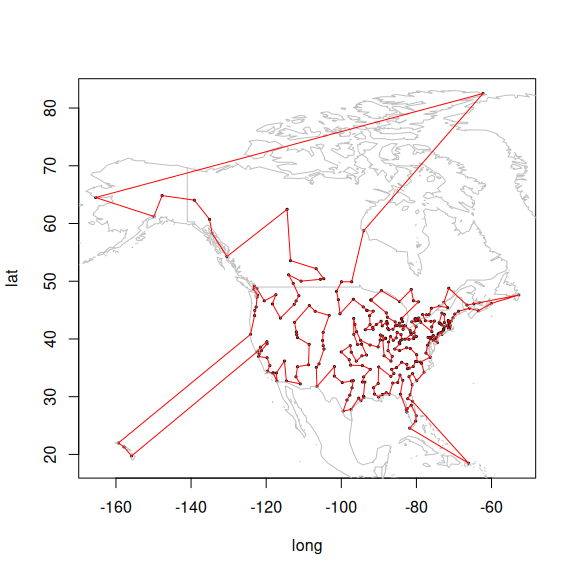
An online example application of TSP can be found on shinyapps.
You can find Q&As and ask your own questions at https://stackoverflow.com/search?q=TSP+R
Please submit bug reports to https://github.com/mhahsler/TSP/issues
Applegate, David, Robert E. Bixby, Vasek Chvátal, and William Cook. 2000. “TSP Cuts Which Do Not Conform to the Template Paradigm.” In Computational Combinatorial Optimization, Optimal or Provably Near-Optimal Solutions, edited by M. Junger and D. Naddef, vol. 2241. Lecture Notes in Computer Science. Springer-Verlag. https://doi.org/10.1007/3-540-45586-8_7.
Applegate, David, Robert Bixby, Vasek Chvátal, and William Cook. 2006. Concorde TSP Solver. https://www.math.uwaterloo.ca/tsp/concorde.html.
Applegate, David, William Cook, and Andre Rohe. 2003. “Chained Lin-Kernighan for Large Traveling Salesman Problems.” INFORMS Journal on Computing 15 (1): 82–92. https://doi.org/10.1287/ijoc.15.1.82.15157.
Bock, F. 1958. “An Algorithm for Solving “Traveling-Salesman” and Related Network Optimization Problems.” Unpublished manuscript.
Croes, G. A. 1958. “A Method for Solving Traveling-Salesman Problems.” Operations Research 6 (6): 791–812. https://doi.org/10.1287/opre.6.6.791.
Hahsler, Michael, and Kurt Hornik. 2007. “TSP – Infrastructure for the Traveling Salesperson Problem.” Journal of Statistical Software 23 (2): 1–21. https://doi.org/10.18637/jss.v023.i02.
Kirkpatrick, S., C. D. Gelatt, and M. P. Vecchi. 1983. “Optimization by Simulated Annealing.” Science 220 (4598): 671–80. https://doi.org/10.1126/science.220.4598.671.
Lin, S. 1965. “Computer Solutions of the Traveling-Salesman Problem.” Bell System Technology Journal 44: 2245–69.
Or, I. 1976. “Traveling Salesman-Type Combinatorial Problems and Their Relation to the Logistics of Regional Blood Banking.” PhD thesis, Northwestern University.
Reinelt, Gerhard. 1991. “TSPLIB—a Traveling Salesman Problem Library.” ORSA Journal on Computing 3 (4): 376–84. https://doi.org/10.1287/ijoc.3.4.376.
Rosenkrantz, Daniel J., Richard E. Stearns, and Philip M. Lewis II. 1977. “An Analysis of Several Heuristics for the Traveling Salesman Problem.” SIAM Journal on Computing 6 (3): 563–81. https://doi.org/10.1007/978-1-4020-9688-4_3.