
The R package deepSTRAPP employs time-calibrated
phylogenies and trait data to test for differences in
diversification rates between traits over evolutionary time. It
handles continuous, categorical, and biogeographic trait data and
extends the STRAPP test of BAMMtools::traitDependentBAMM()
from the present day to any time step along a phylogeny.
deepSTRAPP models independently the
evolutionary history of continuous, categorical, or biogeographic trait
data and the diversification dynamics of a clade, then tests for a
relationship between ancestral trait values / states / ranges and
diversification rates at any point in time. This flexibility allows
users to identify the specific time-frames of
significance during which diversification dynamics diverged
across traits or geographic regions, thereby disentangling the relative
contributions of past versus recent processes in shaping present
biodiversity patterns.
deepSTRAPP statistical framework is an extension of
the STructured RAte Permutations on Phylogenies (STRAPP) test. STRAPP
tests are based on block-permutations: rates data are
randomized across tips within blocks defined by the diversification
regimes identified on each tip (typically inferred with BAMM). Permuting
within regimes rather than across the whole tree provide the correct
error structure to account for the phylogenetic
pseudoreplication of rates occurring between tips sharing the
same macroevolutionary regime. It requires multiple independent
associations between character states and diversification to yield a
significant macroevolutionary signal (Rabosky & Huang,
2016).
In the context of historical biogeography, deepSTRAPP provides a powerful analytic framework to investigate the Diversification Rate Hypothesis (DRH). The DRH posits that the current heterogeneity in diversity patterns, such as the Latitudinal Diversity Gradient, is mainly due to differences in diversification rates between bioregions. This hypothesis is typically assessed by comparing diversification rates across present-day tips between bioregions, for example with a STRAPP test. However, such tests only compare current rates of diversification that may not be informative about the long-term past dynamics shaping present-day biodiversity. deepSTRAPP overcomes this methodological gap: it enables users to test the DRH by comparing diversification rates at any time step along evolutionary time, providing a quantitative testing framework to disentangle effects of past and current dynamics in explaining current patterns of biodiversity.
Beyond the biogeographic context, deepSTRAPP can test for an evolutionary relationship between phenotypic evolution and diversification dynamics, enabling the detection of the timing of adaptive radiations linking changes in trait states and bursts in diversification. It provides an alternative approach to state-dependent speciation and extinction (SSE) models that jointly model trait evolution and diversification dynamics but are not designed to test for differences at a given point in time.
deepSTRAPP is especially suited for large
phylogenies as the power of the statistical tests is limited by
the number of diversification regime shifts detected on the phylogeny
and used to perform permutation tests (e.g., Doré et al.,
2025). Each macroevolutionary regime acts as an independent event
used to test for differences, therefore the sample size of the tests is
conditioned by the number of macroevolutionary regimes identified.
Larger phylogenies tend to carry more regime shifts, thus hold more
information susceptible to yield a significant test result.
A full deepSTRAPP workflow runs as follows:
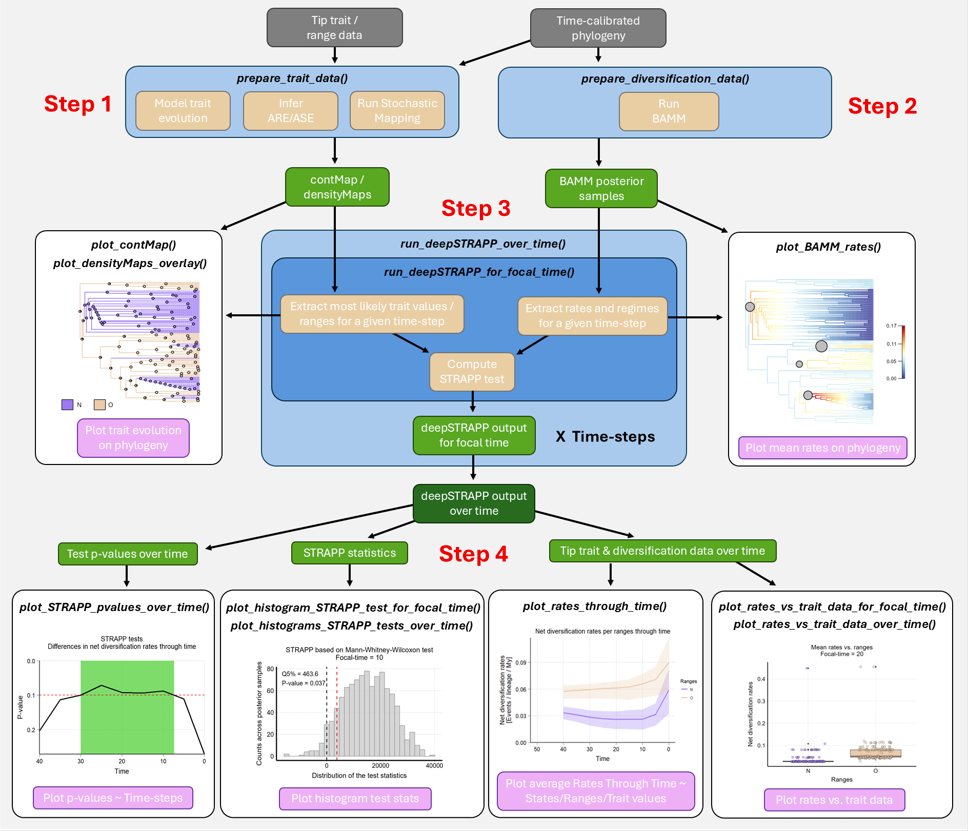 Figure 1: Simplified
deepSTRAPP workflow showing the main functions (in italics)
involved in each step. Input data in grey. Data processing in
blue (main) and beige (internal). Intermediate objects in green. Final
outputs in pink.
Figure 1: Simplified
deepSTRAPP workflow showing the main functions (in italics)
involved in each step. Input data in grey. Data processing in
blue (main) and beige (internal). Intermediate objects in green. Final
outputs in pink.
References:
STRAPP test: Rabosky, D. L., & Huang, H. (2016). A robust semi-parametric test for detecting trait-dependent diversification. Systematic Biology, 65(2), 181-193. https://doi.org/10.1093/sysbio/syv066.
deepSTRAPP application: Doré, M., Borowiec, M. L., Branstetter, M. G., Camacho, G. P., Fisher, B. L., Longino, J. T., Ward, P. S., & Blaimer, B. B. (2025). Evolutionary history of ponerine ants highlights how the timing of dispersal events shapes modern biodiversity. Nature Communications, 16, 8297. https://doi.org/10.1038/s41467-025-63709-3
deepSTRAPP works on R version 4.4 or more. Be sure to have an R
version that is compatible.
See https://CRAN.R-project.org/.
From CRAN, for the latest release:
install.packages("deepSTRAPP")From GitHub, for the current development version, including all example datasets:
library(devtools)

# If you want to have access to the vignettes/tutorials locally, run:
remotes::install_github(repo = "MaelDore/deepSTRAPP")

# Altough, this is time-consuming, you can also opt for this light installation:
remotes::install_github(repo = "MaelDore/deepSTRAPP", build_vignettes = FALSE)
# You will not have access to the vignettes/tutorials within R, but can still acess them through this website.
# See the dedicated Sections below.
You may need additional tools for package compilation such as Rtools
(Windows) and Xcode (Mac OS).
See this
page for details.
deepSTRAPP relies on other software and R packages to perform
some of its core tasks. R package dependencies will automatically be
downloaded and installed alongside deepSTRAPP. However, R packages that
are not currently available on CRAN, and external software may need to
be installed independently.
Reference:
Rabosky, DL. Automatic detection of key innovations, rate shifts, and diversity-dependence on phylogenetic trees. PLoS One 9, e89543 (2014). DOI: https://doi.org/10.1371/journal.pone.0089543
library(devtools)
devtools::install_github(repo="nmatzke/BioGeoBEARS")
For more information, please refer to the official BioGeoBEARS Wiki.
Reference:
Matzke, Nicholas J. (2018). BioGeoBEARS: BioGeography with Bayesian (and likelihood) Evolutionary Analysis with R Scripts. version 1.1.1, published on GitHub on November 6, 2018. DOI: http://dx.doi.org/10.5281/zenodo.1478250
library(devtools)
devtools::install_github(repo="bstaggmartin/contsimmap")
Reference:
Martin, B. S., & Weber, M. G. (2026). Stochastic character mapping of continuous traits on phylogenies. Systematic Biology, syag031. DOI: http://doi.org/10.1093/sysbio/syag031
install.packages("drat")
drat::addRepo("maeldore", "https://maeldore.github.io/drat")
install.packages(c("BioGeoBEARS", "contsimmap"))
A companion website is available to browse interactively the
different tutorials and functions of deepSTRAPP at this
URL: https://maeldore.github.io/deepSTRAPP/.
An overview of all functions and datasets is available here.
A simple use-case that shows how deepSTRAPP can
be used to test for differences in diversification rates between
two trait states along evolutionary times is available here
and within R: vignette("main_tutorial").
This tutorial presents the main functions in a typical
deepSTRAPP workflow.
For more advanced uses,
please refer to the vignettes/tutorials below.
Tutorials are available to explore more advanced
usages of deepSTRAPP. They provide explanations on available
arguments and interpretations of results of deepSTRAPP across multiple
types of data. They are listed below, in the companion
website, and in this vignette:
vignette("deepSTRAPP").
1/ Full deepSTRAPP workflows on different types of data
vignette("deepSTRAPP_continuous_data").vignette("deepSTRAPP_categorical_data").vignette("deepSTRAPP_biogeographic_data").2/ Explore options for trait evolution
vignette("model_continuous_trait_evolution").vignette("model_categorical_trait_evolution").vignette("model_biogeographic_range_evolution").3/ Explore options for BAMM
vignette("model_diversification_dynamics").4/ Explore the STRAPP test options
Test
different hypotheses:
vignette("explore_STRAPP_test_types").
5/ Plot rates through time (RTT)
vignette("plot_rates_through_time").6/ Handle uncertainty
Handle
uncertainty in trait and rate estimates:
vignette("handle_uncertainty").
Explore the three strategies available:
7/ Import external analyses
Import
external analyses:
vignette("import_external_analyses").
Import and format results of external analyses of trait-evolution histories and diversification dynamics, and make them ready-to-use as inputs for a deepSTRAPP run.
8/ Cut phylogenies
Cut
different types of (mapped) phylogenies for a given
focal-time: vignette("cut_phylogenies").
Alternatively, if you prefer to view the vignettes in R, you can
install the package with build_vignettes = TRUE. But be
aware that some vignettes can be slow to generate.
remotes::install_github(repo = "MaelDore/deepSTRAPP",
                        dependencies = TRUE,
                        upgrade = "ask",
                        # Time-consuming, but needed if you want to have access to the vignettes/tutorials
                        build_vignettes = TRUE)

# Access vignettes within R
vignette("deepSTRAPP")

# You can also use this to open access to all local vignettes in an HTML Brower
utils::browseVignettes(package = "deepSTRAPP")
Thank you for finding it! Head over to the GitHub Issues
tab and let me know about it.
You can also
send me an e-mail.
For any use of deepSTRAPP:
Doré, M., & Blaimer, B. B., deepSTRAPP: Testing for differences in diversification rates over deep evolutionary time. (DOI TBA)
As deepSTRAPP relies strongly on functions designed for the phytools R package, it is good practice to also cite this package:
Revell, L. J. (2024) phytools 2.0: an updated R ecosystem for phylogenetic comparative methods (and other things). PeerJ, 12, e16505. https://doi.org/10.7717/peerj.16505.
If you use the modeling tools for continuous and categorical trait evolution embedded in the function prepare_trait_data(), you should cite the R package geiger:
Pennell, M.W., J.M. Eastman, G.J. Slater, J.W. Brown, J.C. Uyeda, R.G. FitzJohn, M.E. Alfaro, and L.J. Harmon. 2014. geiger v2.0: an expanded suite of methods for fitting macroevolutionary models to phylogenetic trees. Bioinformatics 30:2216-2218. https://doi.org/10.1093/bioinformatics/btu181.
If you specifically use the function prepare_trait_data() to produce continuous stochastic maps, you should cite the R package contsimmap:
Martin, B. S., & Weber, M. G. (2026). Stochastic character mapping of continuous traits on phylogenies. Systematic Biology, syag031. https://doi.org/10.1093/sysbio/syag031.
If you use the modeling tools for historical biogeography embedded in the function prepare_trait_data(), you should cite the R package BioGeoBEARS:
Matzke, N. J. (2013). Probabilistic historical biogeography: new models for founder-event speciation, imperfect detection, and fossils allow improved accuracy and model-testing. Frontiers of Biogeography, 5(4). https://doi.org/10.21425/F5FBG19694.